
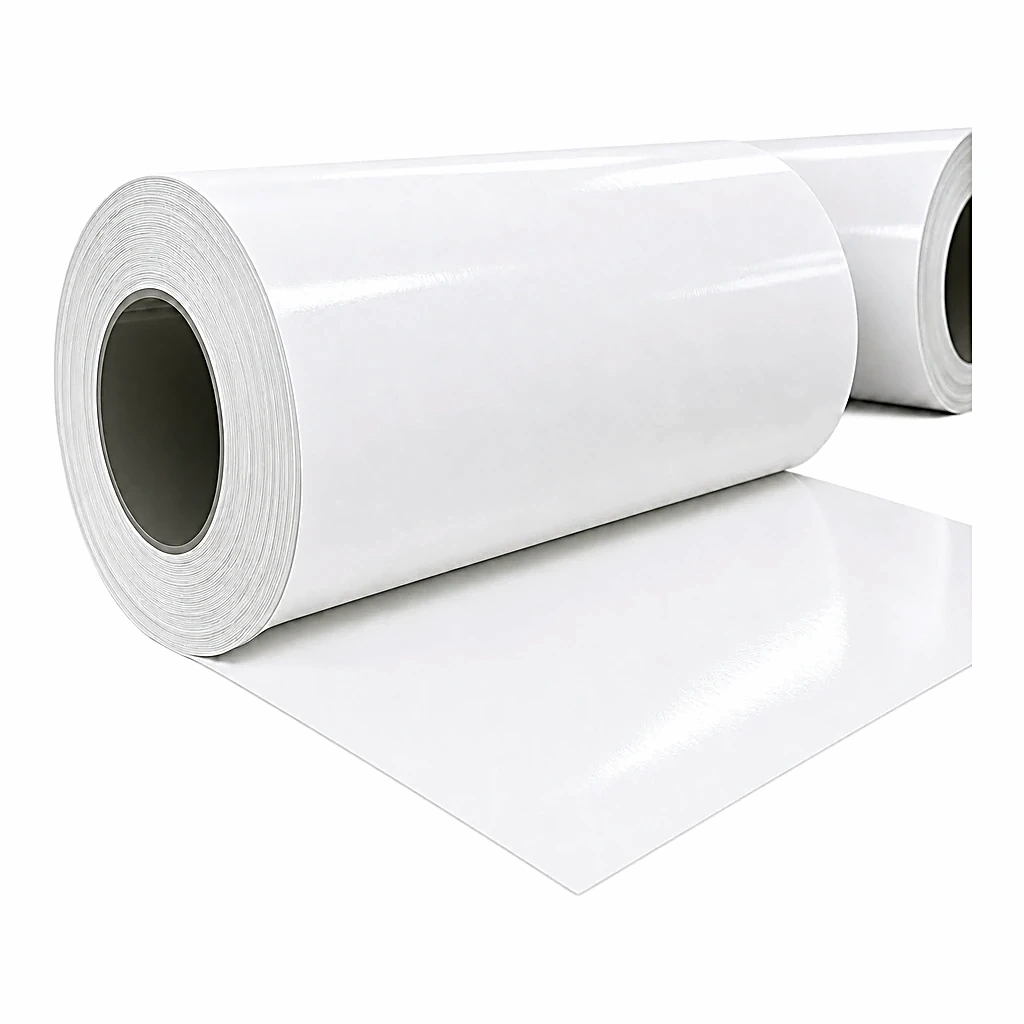
Single-skin FRP gelcoat sheet in rolls,
for yards and interior fabricators building boat interior liners, bulkhead facings and cabin joinery faces.
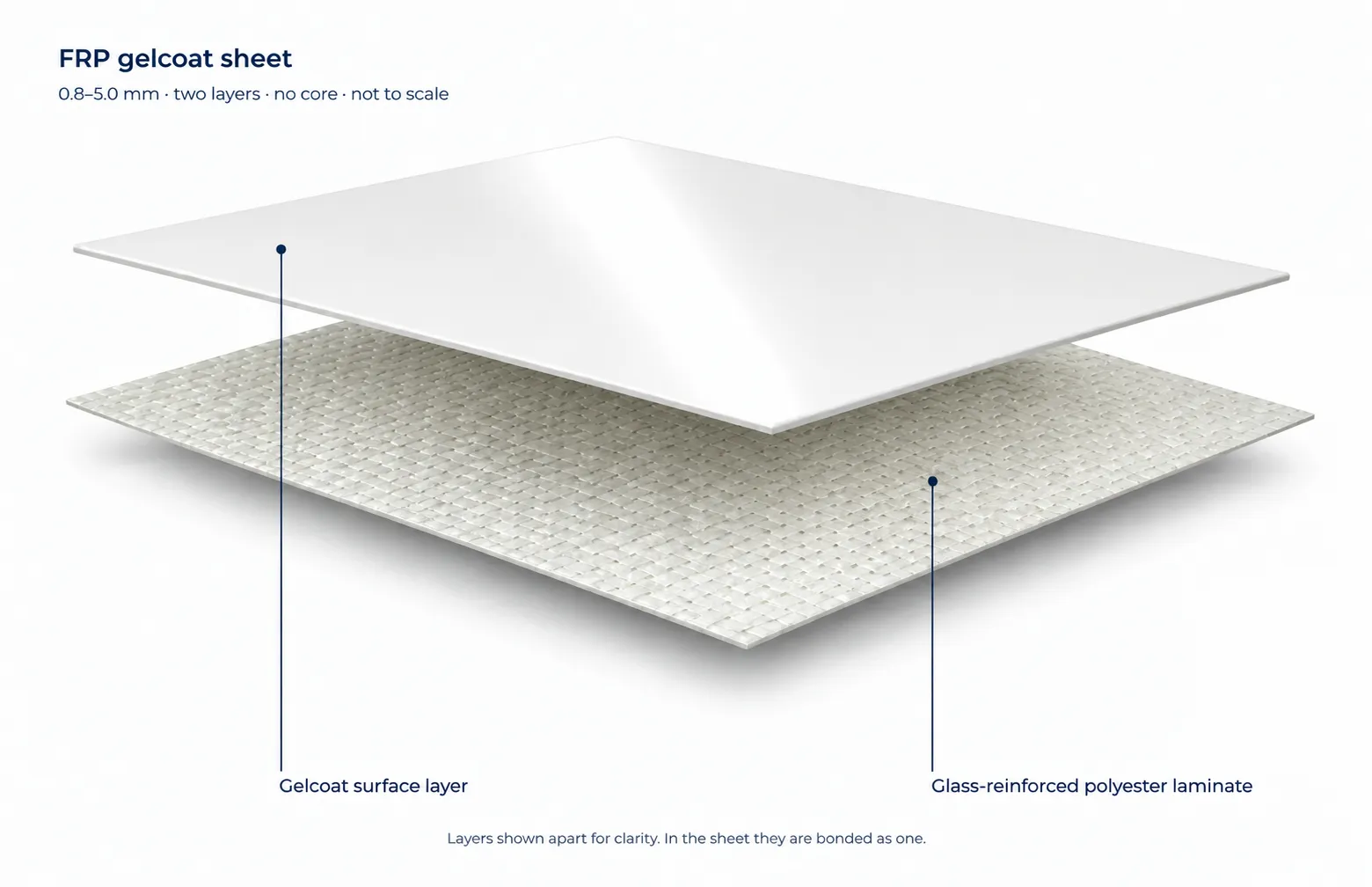
Thickness ranges from 0.8 mm to 5.0 mm. Rolls are supplied up to 3,400 mm wide and up to 120 m long. Behind the gelcoat sits a glass-reinforced polyester laminate; there is no core between them. FRP Gelcoat Panels is the product line, and the single-skin sheet is the boat interior liner face this page covers.
It is a facing sheet — not a complete insulated sandwich panel, and not a structural hull laminate. Its job is the finished face of a boat interior liner: the hull-side lining, ceiling panels, bulkhead facings and cabin joinery.
The image shows that build-up drawn apart: the gelcoat face on top, the laminate below, nothing between them. What a fabricator makes from the same sheet, bonding it to a core or a substrate, is a different article — its thickness, weight and fire behaviour belong to the build-up, not to the skin on its own. When quotations are compared, check which of the two is being priced: a square-metre price for the skin is not comparable with a price for the finished panel.
Buyers typically approach this sheet in one of two ways.
A yard or interior fabricator orders the sheet and builds the boat interior liner in-house. The questions are about the line: whether the gauge suits the laminate schedule, whether the width covers a panel without a join, whether the roll length suits handling, whether the colour repeats between rolls.
A panel fabricator orders the same sheet as one input to a finished interior panel. The sheet specification does not stop mattering at that point — gauge, resin system, surface and bonding compatibility all carry through into the panel — and the panel then adds its own structural, weight and fire requirements on top.
For a finished structural panel — decks, bulkheads, engine room partitions — the sandwich range is set out on our Marine & Yacht page, with honeycomb and PET cores.
| Position | What the face has to do |
|---|---|
| Interior hull-side lining and ceiling | Hide structure behind something cleanable and coloured |
| Bulkhead facing | Finish a core or a structural panel |
| Cabin joinery: berths, lockers, galley units | Take knocks and stay cleanable |
| Head and shower cubicle | Designed to be washed routinely; edges and joints sealed per the design |
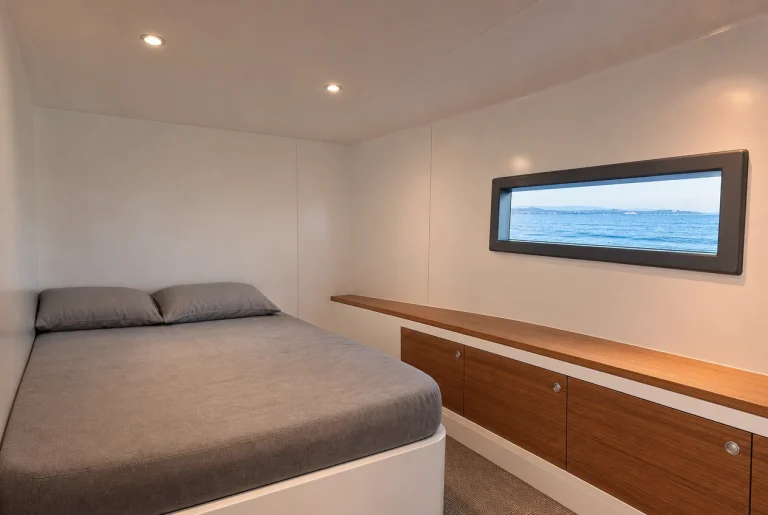
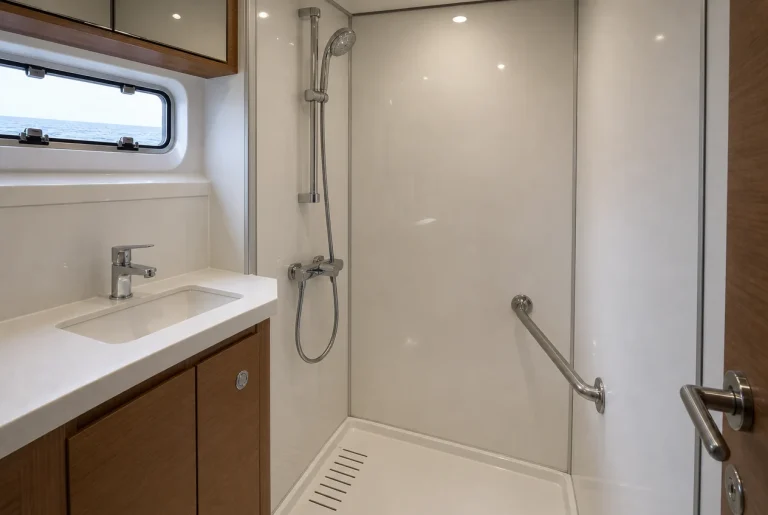

Any of these positions is subject to confirmation. The thickness, the substrate and the fixing method are settled per project, and not every application suits every gauge.
Two limits apply before anything else. The sheet is not intended for below-waterline or structural hull work. And on a classed vessel, fire performance is judged against the requirement that applies to the vessel and to the location of the material — not assumed from the facing alone.
The sheet is produced in unsaturated isophthalic polyester, chosen over the general-purpose orthophthalic grade for its better resistance to moisture.
That is a material difference, not a marine approval. How a sheet performs in service also depends on the resin formulation, the laminate construction, the cure, the gelcoat, the way it is bonded and the exposure it actually sees. Suitability for a given position is therefore confirmed against the project’s conditions rather than inferred from the resin class.
Moisture that never leaves. A boat interior is humid as a condition, not an event: vapour in the air, condensation on cold structure, spray carried in on gear. The face is in contact with it continuously.
Cleaning, and the agents used. The smooth, closed gelcoat face is designed to be easy to clean. Whether a surface resists mould, and whether a particular cleaning agent is compatible, depends on the formulation, the surface condition and the cleaning regime — tell us what the yard uses and we will confirm.
Contact from gear and crew. Lockers, fittings and people hit interior faces. The outcome of a given knock depends on the gauge, on what sits behind the sheet, and on the force involved; a thin facing and a heavy one do not behave alike.
Movement and bonding. The sheet has to be bonded or fixed to a suitable substrate with a system compatible with both materials and with the movement the structure sees. The substrate, the adhesive and the fixing method are confirmed for each application.
| Item | Detail |
|---|---|
| Sheet Thickness | 0.8 mm–5.0 mm (single-skin sheet) |
| Max Width | up to 3,400 mm |
| Roll Length | up to 120 m |
| Resin System | Unsaturated isophthalic polyester (laminate layer) |
| Colours | Custom RAL available |
| Surface Finish | Smooth glossy (standard); textured finishes quoted per project |
| Warranty | 10–15 years, subject to application and order terms; confirmed at quotation |
Two notes on the table. The isophthalic grade is the laminate resin; the gelcoat layer is formulated separately for the colour and finish, and its own resin can be confirmed in writing on request. Textures available across the line include wood grain, trefoil (anti-slip), bubble, pearl and leather — the smooth glossy face is what interior liner work almost always takes, and availability of a texture on this sheet is confirmed per project and quoted that way.
The sheet is supplied in full rolls. Cutting, trimming and nesting are carried out by the customer or their fabricator; we do not supply pieces cut to a panel schedule.
A: No. It is a boat interior liner, not a hull laminate. Immersion work needs a laminate specified for it, and that is a different product.
A: Unsaturated isophthalic polyester in the laminate layer. The gelcoat layer is formulated separately for its colour and finish, and its resin can be confirmed in writing on request. This product is not designed for permanent immersion.
A: No. The sheet neither insulates nor replaces a structural panel. It brings its own stiffness and mechanical properties to the build-up, but how the finished liner performs depends on the sheet thickness, the substrate, the bonding or fixing method and the construction as a whole.
A: This page covers interior liners. An exterior marine face sees UV, salt spray and sun at a level that calls for a separately specified gelcoat system, so we treat it as a separate enquiry. Tell us the position and the exposure and we will say whether we can quote it.
A: The gelcoat surface is designed to be easy to clean. Resistance to mould growth, and compatibility with cleaning chemicals, depend on the formulation, the surface condition, the agent and its concentration and contact time. Tell us what the regime uses and we will confirm suitability.
A: Only as a surrounding surface. The sheet is a cabin finish, and we would not specify it for direct contact with food; a galley unit that needs a food-contact face takes a different product — see Food Grade Gelcoat Panels, or send us the requirement and we will confirm which one fits.
A: That is decided by your process as much as by the sheet: the substrate, the adhesive and the surface preparation all matter, and a contaminated or unprepared back face can fail where a properly prepared one holds. Tell us what you are bonding to and we will confirm the back-face options before you order; a trial lamination on your own line stays the most reliable test.
A: Available thicknesses range from 0.8 mm to 5.0 mm. The appropriate gauge depends on the laminate schedule, the substrate, the installation method and the expected service loads. Liner faces and furniture faces may require different thicknesses. Send us the application details and we can help confirm a suitable specification.
A: We do not currently hold a marine fire test report for this sheet. Requirements depend on the vessel type, the applicable regulations and the installation location; where testing is specified, the specimen and the approval scope may depend on the facing, the substrate, the adhesive and the installation configuration. Tell us the classification and fire requirements that apply and we will confirm what documentation is available. ASTM reports and SGS documentation held for other properties or other products do not establish marine fire compliance for this sheet.
A: No. The FRP gelcoat sheet is supplied as rolls, and cutting happens at your end.
We’d love to hear about your project — reach out anytime.
Thank you for contacting us,
we will get back to you in 24hrs!