The global marine composite market grows from USD 3.25 billion in 2026 to USD 5.85 billion by 2035 at a 6.7% CAGR. Two independent research houses put the 2025 base at USD 3.04 billion, which makes the base year unusually solid. The useful part for a panel supplier is not the headline figure but the split behind it: interior structures are tracked as an application category in their own right, glass fiber still takes 61.4% of the market by fiber type, and boat builders are replacing steel, aluminium, and wood with fiber-reinforced polymer. Marine composite panels are what that demand lands on.
What the Numbers Say
| Metric | Figure |
|---|---|
| Market size, 2025 | USD 3,040.6 million |
| Market size, 2026 | USD 3,254.8 million |
| Forecast size, 2035 | USD 5,847.3 million |
| CAGR, 2026-2035 | 6.7% |
| Absolute revenue opportunity, 2026-2035 | USD 2,592.5 million |
| Glass fiber share, by fiber type, 2025 | 61.4% |
| Hulls and decks share, by application, 2025 | 52.3% |
| Asia Pacific share, by region, 2025 | 36.8% |
Source: Reports and Data, Marine Composite Market, 2026-2035.
Two forecasters, two different end points, one shared starting line. The Insight Partners projects US$ 5.62 billion by 2034 from the same US$ 3.04 billion 2025 base, at a 7.1% CAGR. Reports and Data reaches USD 5,847.3 million by 2035 at 6.7%. Read the 6-7% band as the signal and the closing values as estimates — the two houses disagree on where the curve stops, not on which way it points.
Three details matter more than the total. Glass fiber, the reinforcement inside FRP, holds 61.4% of the market by fiber type, so this is a glass-fiber market before it is anything else. Hulls and decks take 52.3% of applications, but interior structures are tracked as a separate category — and that is the segment a panel supplier actually serves. Asia Pacific holds 36.8% of revenue and is both the largest and the fastest-growing region, with China the leading country.
The Broader Build-Out Behind It
The driver here is substitution rather than new demand. Boat builders and shipyards are replacing traditional steel, aluminium, and wood construction with fiber-reinforced polymer, because it delivers a combination metals struggle to match on weight, corrosion, and structural strength at the same time. A lighter vessel burns less fuel and a non-corroding one needs less maintenance, and both of those now sit high on a buyer’s list.
Power boats lead by vessel type with 38.6% of 2025 revenue, and naval and defence vessels are the fastest-growing category as navies modernise. Within applications, masts, spars, and foils are the fastest-growing sub-segment.
The restraint is worth stating plainly rather than skipping. Aluminium and steel still win many commercial and naval structural applications on cost and established fabrication infrastructure, and resin and fiber feedstock prices are volatile. This is a market compounding at 6-7%, not one being replaced overnight — which is exactly the pace a panel supplier can plan capacity against.
What Marine Composite Panels Have to Deliver
Saltwater, humidity, and UV set the baseline. A marine panel has to survive all three without corroding, absorbing moisture, or degrading — and keep the vessel’s weight down while doing it. Weight is not a secondary concern in this application: it feeds directly into fuel efficiency and into how a hull behaves in rough water.
Those requirements resolve into four things:
- Corrosion resistance — the FRP gelcoat skin resists saltwater exposure, unlike steel panels, which rust in marine environments
- Strength-to-weight ratio — a honeycomb core delivers structural rigidity for bulkheads and decks without the weight of a solid or plywood core
- Moisture resistance — PET core resists water absorption, which suits interior components exposed to humidity
- Weight reduction across the build — lighter panels support fuel efficiency and performance, not just easier handling
One boundary is worth stating before the specification table. SKD’s FRP panels are engineered for corrosion and moisture resistance in typical above-deck and interior marine applications. For fully submerged or hull-specific structural applications, talk to our team about the project’s requirements rather than assuming a general-purpose panel will fit.
Specifications That Decide Whether a Panel Works
Panel width is where marine specifications most often stall, because the two panel types ship differently and cannot be described by one number.
| Specification | Value |
|---|---|
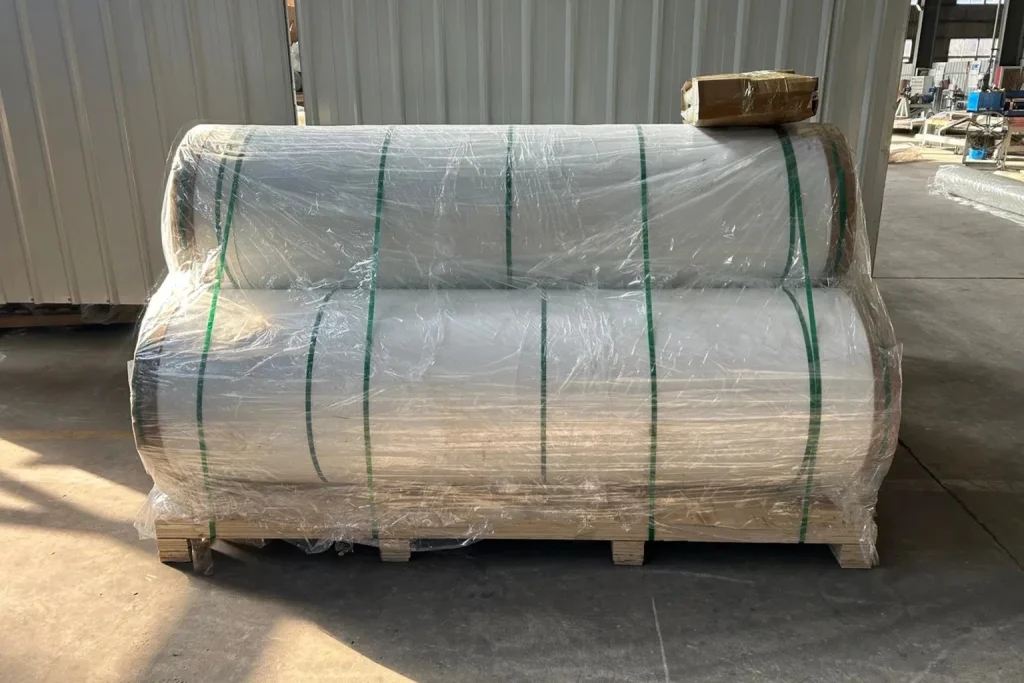
| Gelcoat panel width | Produced up to 3,400mm wide — supplied in roll form, not limited by container width |
| Sandwich panel width | Produced up to 3,400mm wide; up to 2,200mm per panel ships in a standard container |
| Sandwich panel length | Produced to order; up to 11,800mm per panel ships in a standard container |
| Core options for marine | Honeycomb / PET |
| Skin material | FRP gelcoat (outer) + FRP (inner) |
| Warranty | 10-15 years, consistent with FRP Gelcoat Panels |
Shipping note: gelcoat panels are supplied in roll form and loaded with the roll axis along the container length, so panel width is not capped by the container’s internal width. That is why gelcoat panels are available up to 3,400mm wide, while rigid sandwich panels ship at a maximum width of 2,200mm.
A rigid sandwich panel cannot be rolled, so the container sets what can ship. In practice width is the limit that catches most marine specifications, since a 2,200mm ceiling is far more restrictive than the 11,800mm length. We work through the full reasoning in FRP panel sizes and container shipping limits. Tell us your panel sizes and destination port and we will confirm what ships for your project.
What SKD Supplies for Marine and Yacht Projects
Every sandwich panel we supply is built on the same two-skin structure — an FRP gelcoat outer skin, a selected core, and an FRP inner skin — with the core chosen for the part of the vessel it serves.
| Component | Panel to specify |
|---|---|
| Bulkheads and decks | FRP honeycomb core sandwich panel — high strength-to-weight ratio, the core to start from where rigidity per kilogram matters |
| Interior components | FRP PET core sandwich panel — lightweight and water-resistant, suited to humidity-exposed interiors |
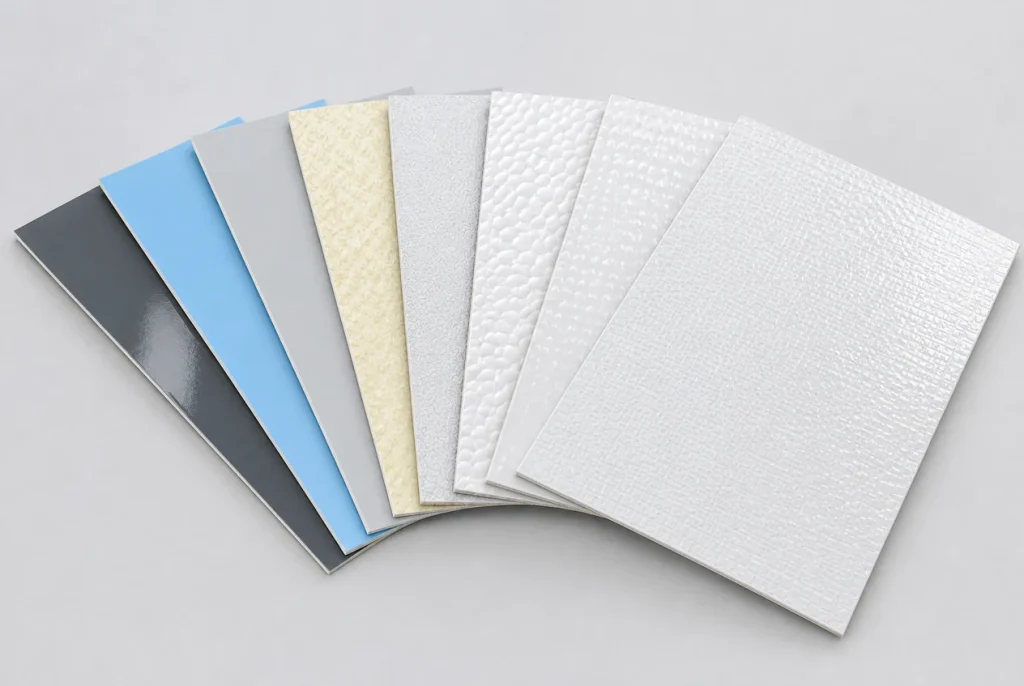
| Decorative surfaces | Standard FRP gelcoat panel — factory-finished surface, ready to install out of the roll |
All three panel types are covered on our FRP panel systems for marine and yacht construction page, alongside the panel structure and construction details at technical information. For a wider view of where these panels are used, see all FRP panel applications.
For bulkheads and decks, the panel specification should be set against the vessel’s own structural design and applicable class requirements — the panel is one component of the build-up, not a substitute for project-level engineering.
How to Choose
Start from the load case and the weight budget, then let the core follow. Honeycomb goes where rigidity per kilogram decides the part, PET goes where humidity is the threat and weight still matters, and a gelcoat panel goes on the surfaces a passenger actually sees. Most marine composite panels are specified in one of those three ways, and the choice rarely stays open once the load case is defined.
Two habits save time later:
- Fix width and shipping route before thickness and core. Width is the constraint that moves a marine schedule, not length.
- Decide the join up front. If a rigid sandwich panel needs to exceed 2,200mm wide, plan the split and the on-site joint rather than discovering the limit at the port.
Frequently Asked Questions
Which core is better for bulkheads and decks — honeycomb or plywood?
Honeycomb core offers a higher strength-to-weight ratio than plywood, which matters in marine applications where minimising weight while maintaining rigidity is the priority. Plywood core is heavier and better suited to land-based high load-bearing applications.
Are FRP panels suitable for below-deck or fully submerged applications?
SKD’s FRP panels are engineered for corrosion and moisture resistance in typical above-deck and interior marine applications. For fully submerged or hull-specific structural applications, contact our team to discuss the project’s specific requirements.
Can panel dimensions be customised for a specific vessel?
Yes. Panel thickness is made to order. For sandwich panels, width is sized to standard container dimensions; gelcoat panels are supplied in roll form and are not capped by container width. Contact our team to confirm specifications for your vessel construction project.
What is the difference between a gelcoat panel and a sandwich panel in a marine build?
A gelcoat panel is a single-skin FRP sheet with a factory-finished face — the right choice for visible decorative surfaces. A sandwich panel bonds an FRP skin to a structural or insulating core, which is what bulkheads, decks, and interior components need.
How wide can marine composite panels be?
Gelcoat panels are produced up to 3,400mm wide and supplied in roll form, so they are not limited by container width. Rigid sandwich panels are produced to the same 3,400mm width but ship at a maximum of 2,200mm wide and 11,800mm long per panel in a standard container.
Get in Touch
Tell us the part of the vessel, the load case, and whether weight or moisture resistance is the deciding factor. Send us your panel sizes and destination port, and we will confirm the specification and the shippable sizes for your project.
sales@skdscci.com | +8615033490654