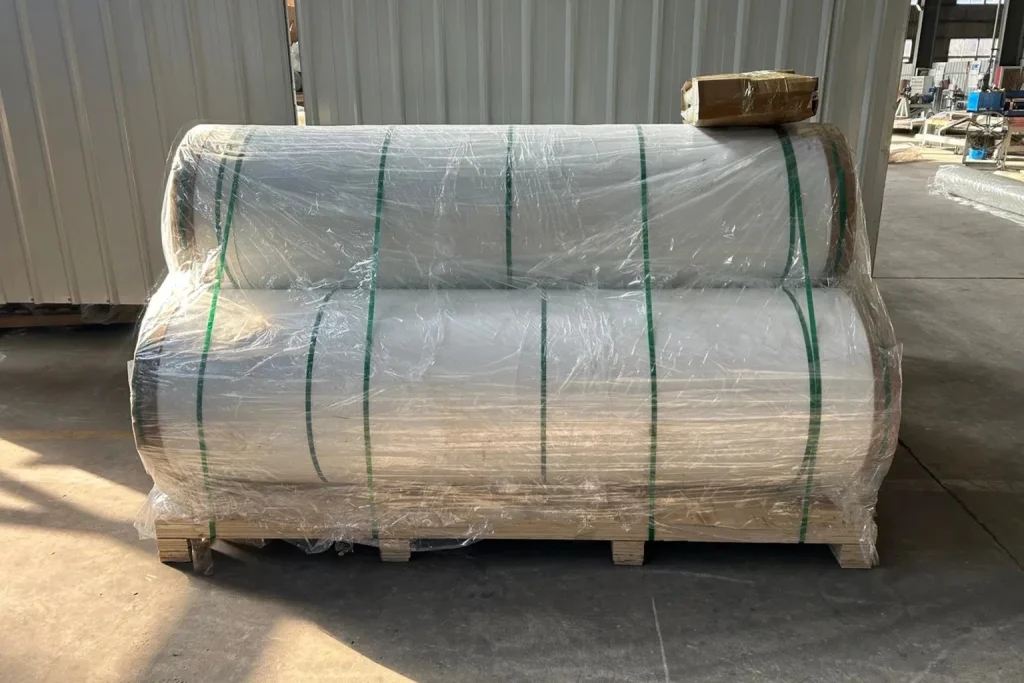
An FRP panel receiving inspection has to cover two formats. The panel arrives either as a roll or as a flat board, and those two arrive differently enough that one checklist does not serve both. What they share is timing. The delivery note is a document you sign once, and what you write on it, or leave off it, becomes the record you argue from months later.
Inspect before you sign, not after
Signing a clean delivery note can be treated as acceptance. If the load is sound, that is fine and the rest of this page is routine. If it is not, the signature is the moment your position changes from buyer holding evidence to buyer making a request.
A first pass takes under an hour for most loads, and needs a tape measure, a caliper and a phone camera.
Finished panels are inspected before packaging and shipment, so what you are doing at the dock is a cross-check rather than a first look. That is not a reason to skip it. Most problems found at the dock happen in transit or handling.
There are days when a full inspection at the dock is not realistic. Rain, no light, no room to lay a panel out. In that case sign with a written reservation, something as short as “received subject to inspection”, and finish the check before the window closes. Ask what that window is before the load ships. Carriers and countries differ, and it is not a thing you can negotiate afterwards.
Before the banding comes off
Photograph the load as it sits. A stack that has shifted in transit explains a crushed corner ten minutes later, and once you have unloaded it the explanation is gone.
Count against the packing list. Rolls and panels are counted differently: rolls by number and length, panels by number and size. If the list gives a count and nothing else, ask for dimensions on the next shipment.
Look at the outside of the pack. Puncture, crush and water staining are worth a photograph before anything is opened, because the moment you cut the wrap the question becomes whether the damage came from the journey or from your own unloading. Packaging is worth matching against what was agreed on the order. If the order did not specify it, that is the first thing to settle next time.
Write down the batch or lot number and the finish code. Colour questions that surface three months into a project get answered by batch, not by eye.
Paperwork is part of the delivery, and it is the part people forget. If the order was to include test reports or certification documents, confirm they travelled with the load. A report that turns up three weeks later is awkward to attach to a claim you filed in week one.
Is that scratch in the film or in the panel?
This depends on the line, so start with what was ordered.
SKD’s standard gelcoat sheet ships with a peelable protective PET film over the gelcoat face, taken off once the panel is in place. Where a film like that is applied, the surface you can see is not the surface you are judging. A mark may sit in the film and leave nothing behind, or it may have gone through. Through the wrapping, both look alike.
Peel a corner back on the suspect area. A hundred millimetres is enough. Look at the gelcoat underneath, then let the rest of the film stay where it is, because it is doing useful work until installation. If you want certainty across a batch, corner-peel one sheet per batch rather than stripping a whole panel.
Where no film is applied, the face you see is the face you are judging, and a scratch at the dock is a scratch on the panel.
The gelcoat layer itself is sometimes described as a factory-glazed film, because that is what it is: fused onto the laminate during production. It does not peel. If a corner of it lifts under a fingernail, that is delamination rather than packaging, and it wants reporting as a defect.
Rolls and rigid panels: two different failure modes
Gelcoat sheet is supplied in roll form, up to 120 m on a roll and produced up to 3,400 mm wide. Because it rolls, container width does not cap what ships, so a wide sheet reaches you without a longitudinal join.
The exposure on a roll is at the laps. Check the outer lap, both ends, and the roll core (tube). Check that the banding is still tight, and that the roll has not flattened or taken a set where it rested against a pallet. Damage further in only shows when you unroll, so unroll the first two or three metres at the dock and rewind in the same direction.
Rigid sandwich panels are the other geometry. They ship flat, up to 2,200 mm per panel and up to 11,800 mm long inside a standard container. Both figures are container limits rather than line limits. Here the crush points are corners and edges. Check face flatness, check whether panels have been stood on edge and bowed, and check whether the stack has slid against the strapping.
The four numbers worth measuring
Thickness. Gelcoat sheet runs 0.8 to 5.0 mm. Take three readings across a sheet rather than one, since a single number cannot show a taper.
Width. Produced up to 3,400 mm. It is easier to measure on the first metre you unroll than on the roll itself.
Length. Rolls run up to 120 m, or are cut to order. Match the label to the order rather than measuring a full roll on the dock.
Count. Rolls or panels against the packing list, with dimensions written next to the number.
If something is wrong, photograph it where it lies
Four photographs cover most claims. The load as it sits, the damage with something for scale in frame, the label with the batch number, and the packing list.
Write the note on the delivery note before the driver leaves, and ask for it to be countersigned. Then open two conversations, one with the carrier and one with the supplier. They run to different rules and both rest on the same four photographs.
What decides a claim is rarely the size of the damage. It is whether the record was made before the panel moved.
A single damaged panel does not condemn the run. Panels go up as discrete units, so one can be cut out and replaced between loads rather than rebuilding a wall.
Send us the packing list and the photographs. We will tell you what they show, and whether the mark is in the film or in the panel.
This is general guidance. Check your contract and the carrier’s terms: where risk passes to you depends on the Incoterms you agreed.