
The global recreational vehicle (RV) market is projected to grow from $81.56 billion in 2025 to $238.10 billion by 2035, at a compound annual growth rate (CAGR) of 11.31% from 2026 to 2035, according to Precedence Research. For RV and caravan manufacturers — and the FRP panels for RVs that make up their exterior and interior surfaces — the growth is not just in unit volume but in what buyers expect from the vehicle itself.
Market Signals
Three Drivers Behind the Growth
- Outdoor recreation is scaling up. Post-pandemic habits have become permanent: camping, national-park road trips and self-contained travel keep drawing first-time buyers, and rental platforms are bringing younger users into the RV lifestyle without the upfront cost of ownership.
- Luxury and customization are pushing build specs higher. Buyers expect hotel-style comfort on wheels — modular interiors, upgraded kitchens, connected power (solar and lithium), and premium materials. For manufacturers, that means surfaces — inside and out — must deliver a residential-grade look at vehicle weight.
- Smaller, lighter formats are the fastest-moving segment. Compact camper vans and towables suit solo travelers, small families and fuel-conscious buyers — a segment that rewards lightweight construction directly.
Regional Outlook
North America leads the market — the U.S. alone is projected to grow from $32.54 billion (2025) to $96.85 billion by 2035 (11.52% CAGR). Asia Pacific is the fastest-growing region, and China’s RV segment is emerging with government-supported self-driving tourism infrastructure, entry-level motorhomes and growing rental ecosystems.
What This Means for RV Manufacturers
Three material decisions follow directly from these market signals:
- Weight is a selling point, not a spec. With compact campers the fastest-growing format, every kilogram saved in walls, ceilings and furniture translates into payload, fuel economy and range — especially as electric and hybrid RV concepts arrive.
- Surfaces must survive outdoor life and still look good. An RV exterior sits in full sun year-round and must resist UV, temperature swings and road debris without fading, chalking or degrading — for a decade or more. Buyers judge the vehicle on that skin first.
- Customization speed wins orders. Builders that can offer varied colors, textures and panel sizes without long lead times are better positioned as demand shifts toward personalized builds.
FRP Panels: The Standard for RV Exteriors — and Interiors
FRP panels for RVs answer all three points, which is why gelcoat-surfaced FRP is a mainstream specification for RV exterior walls — the seamless outer skin of countless travel trailers, fifth wheels and camper vans. SKD Composite Materials, a China-based FRP gelcoat and sandwich panel manufacturer, supplies FRP panels for RVs and caravans, covering both exterior body panels and interior wall surfaces.
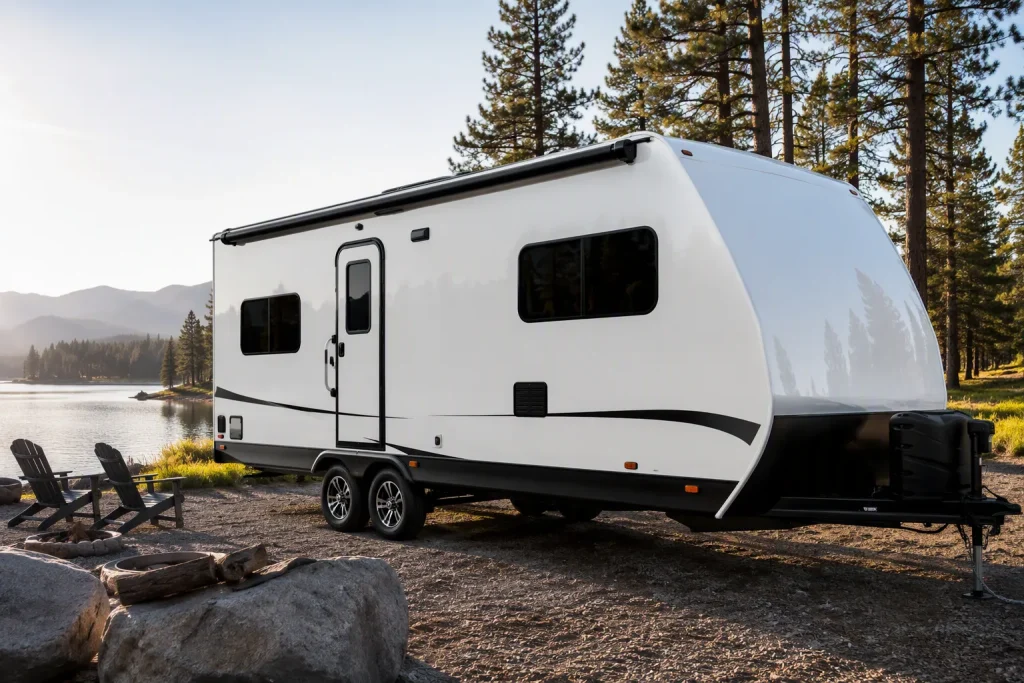
- Seamless, maintenance-free exteriors — FRP gelcoat sheets form continuous outer skins without the seams and fasteners of metal siding, in a smooth white surface that needs no painting. On modern towables and camper vans, this is the dominant exterior paneling system.
- Engineered for full outdoor exposure — SKD’s FRP gelcoat panels (skin thickness 0.8–5.0mm) block over 99% of UV and are rated for continuous use from -40°C to +140°C — the year-round sun, heat and cold an RV exterior lives in.
- Lightweight body structure — honeycomb-core sandwich panels deliver high stiffness at low weight for side walls, floors and furniture, directly supporting the compact-camper trend.
- Interiors benefit too — where interiors need durable surfaces (bathrooms, wet areas, partitions), the same smooth gelcoat finish resists stains, moisture and cleaning chemicals, in custom colors to match the design.

FAQ
Q1: Why do RV manufacturers use FRP panels for exterior walls?
A: FRP panels for RVs form seamless, continuous outer skins that need no painting and stand up to full outdoor exposure — UV, temperature swings, road debris and washing. On modern towables and camper vans, FRP exterior walls are a mainstream specification because they keep a clean, maintenance-free finish for the life of the vehicle.
Q2: How does a seamless FRP exterior compare with metal siding?
A: Metal siding is installed in panels, which means visible seams and fasteners across the body, and it can dent from road debris or hail. A seamless FRP exterior avoids both: no panel seams to catch or leak, and better resistance to minor impacts without permanent denting — a key reason many towable RV builders moved to FRP outer skins.
Q3: Can FRP exterior panels handle years of sun, heat and cold?
A: Yes. SKD’s FRP gelcoat panels are rated for continuous use from -40°C to +140°C and block over 99% of UV, so exterior walls resist fading, chalking and thermal-cycling damage through years of outdoor parking and travel.
Q4: What is the advantage of honeycomb-core sandwich panels in RV construction?
A: Honeycomb cores provide high stiffness at significantly lower weight than solid panels of equal thickness — useful for RV side walls, floors and furniture, where every kilogram affects payload and fuel economy.
Q5: Can panel dimensions and colors be customized?
A: Yes. FRP panels can be supplied in custom colors and surface finishes for both exterior and interior use, with panel thickness and dimensions tailored to the build. Contact the SKD team with your layout for a specification.
Q6: What information should I provide when requesting a quote for RV panels?
A: Share the application (exterior body panels, interior walls, furniture), required dimensions and thickness, quantity, color or surface finish, and any specific performance requirements. The SKD team will recommend the right panel specification.
Get in Touch
We’d love to discuss your project — reach out anytime.
- sales@skdscci.com
- +86 150 3349 0654
Thank you for contacting us — we will get back to you within 24 hours.
Sources (accessed September 7, 2026): Precedence Research — Recreational Vehicle Market (2026–2035) · SKD product pages (skdscci.com)


