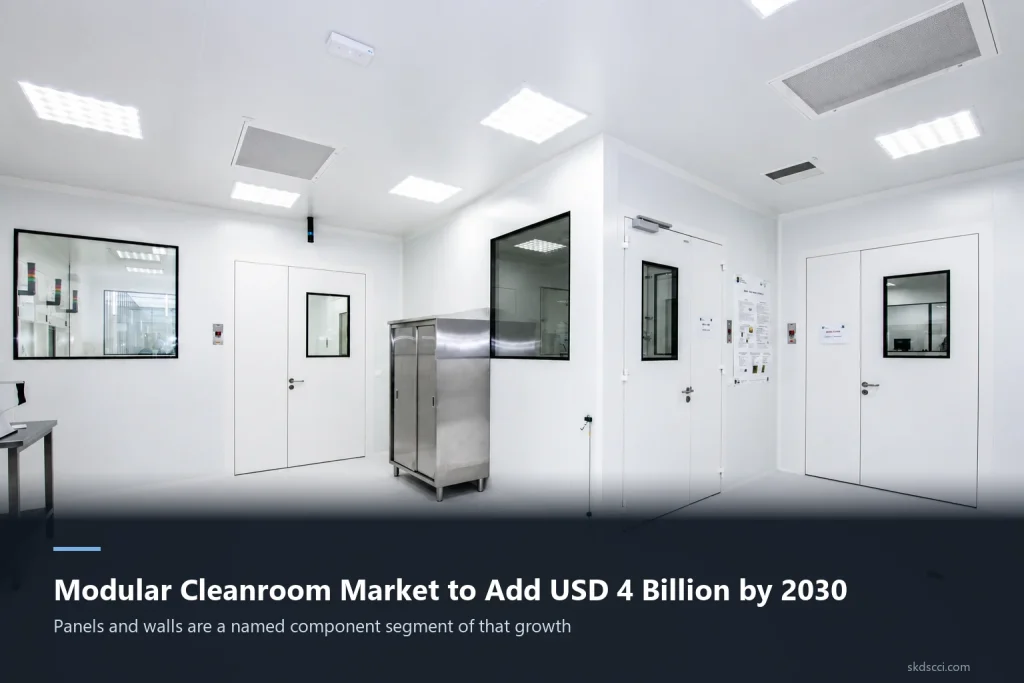
The modular cleanroom market will add USD 4.00 billion between 2025 and 2030, growing at 8.1% a year. That figure matters to panel suppliers for one specific reason: modular cleanroom panels sit in a named component segment of that growth, and a modular cleanroom is a panel system before it is anything else.
What the Numbers Say
| Metric | Figure |
|---|---|
| Market growth, 2025-2030 | USD 4.00 billion |
| CAGR, 2025-2030 | 8.1% |
| North America share of incremental growth | 39.2% |
| Asia Pacific growth rate | 9.0% |
| Largest type by revenue, 2024 | Hardwall |
| Medical segment value, 2024 | USD 3.47 billion |
Source: Technavio, Modular Cleanroom Market Analysis, Size, and Forecast 2026-2030.
Two patterns stand out. North America accounts for roughly 39% of the incremental growth, driven by pharmaceutical and semiconductor investment, while Asia Pacific expands fastest at 9.0%. Hardwall systems hold the largest revenue share among cleanroom types — and hardwall systems are the ones built from rigid, pre-finished panels.
The Broader Build-Out Behind It
Modular cleanrooms do not grow on their own. The wider cleanroom technology market is forecast to move from USD 10.72 billion in 2026 to USD 14.88 billion by 2031, a 6.78% CAGR. In the United States, the USD 53 billion CHIPS and Science Act set off a wave of fab construction: eighteen new plants broke ground in 2025, each requiring ISO 4 or tighter environments. In Europe, biopharma programs are specifying ISO 5-7 modular suites for living-medicine production.
Different sectors, same requirement — a controlled surface that can be validated, cleaned, and repeated identically across a facility.
What Modular Cleanroom Panels Have to Deliver
Off-site fabrication is what makes modular cleanrooms fast. It can cut construction timelines by up to 40% compared with conventional build. That speed only holds if the panels arrive finished. A panel that still needs site coating or field sealing is not a modular panel; it is a delay.
So the specification conversation moves to the panel itself, and it comes down to four requirements.
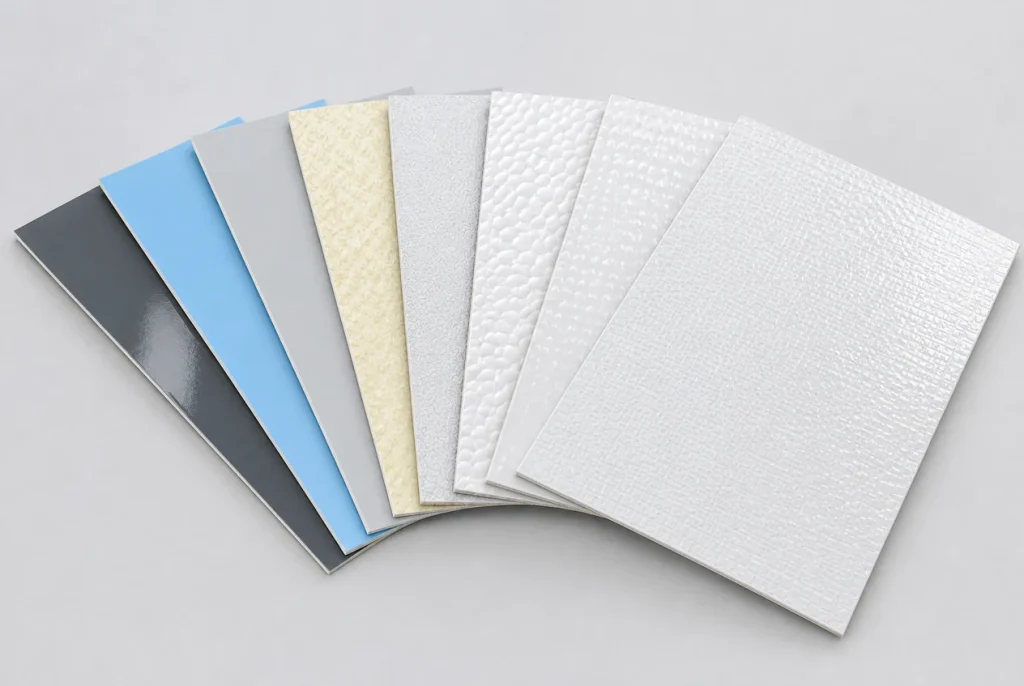
- A smooth, non-porous surface — the glossy FRP gelcoat surface is easy to clean and to inspect for residue
- Resistance to frequent cleaning — smooth surfaces support the repeated washdown and disinfection that cleanrooms require
- Optional antibacterial protection — a dedicated antibacterial gelcoat panel line is available for projects with additional hygiene requirements
- Insulation where temperature control is needed — XPS or PU sandwich panels are available for cleanrooms that also require temperature control
Specifications That Decide Whether a Panel Works
| Specification | Value |
|---|---|
| Surface finish | Glossy |
| Skin thickness | 0.8-5.0mm |
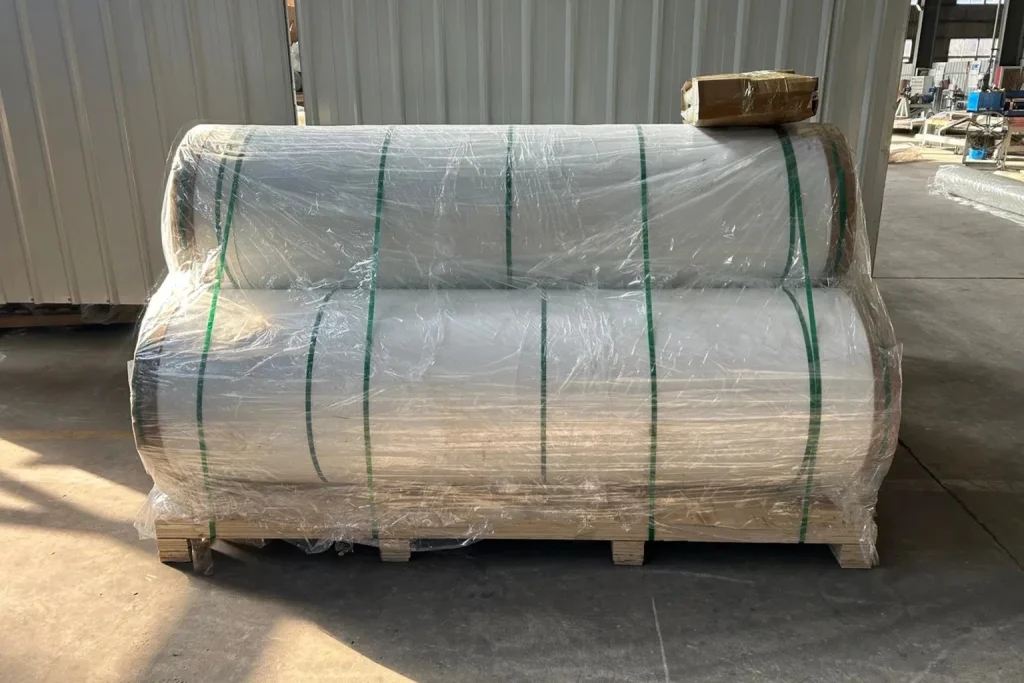
| Panel width, gelcoat | Up to 3,400mm, supplied in roll form |
| Panel width, rigid sandwich | Up to 2,200mm |
| Panel length, rigid sandwich | Up to 11,800mm |
| Antibacterial protection | Third-party tested and verified |
| Warranty | 10-15 years |
One note on panel width, because cleanroom layouts often assume a single wide sheet. FRP gelcoat panels are produced up to 3,400mm wide and supplied in roll form, so panel width is not capped by container dimensions. Rigid sandwich panels — including the insulated XPS and PU options — are produced to the same 3,400mm width, but they ship at a maximum of 2,200mm wide and 11,800mm long per panel in a standard container, because a rigid panel cannot be rolled. Plan wall and ceiling runs around those two figures and the specification will still hold on site.
What SKD Supplies for Cleanroom Projects
- Standard FRP gelcoat panels — glossy finish for hygienic cleanroom walls and ceilings
- FRP antibacterial gelcoat panels — independently tested antibacterial surface protection
- XPS core sandwich panels and PU core sandwich panels — for cleanrooms that also require temperature control
- Test documentation — available on request for select product lines
How to Choose
Most modular cleanroom panels fall into five specification patterns. Match your scope to the row that fits.
| Your cleanroom requires | Panel to specify |
|---|---|
| Hygienic walls and ceilings, no temperature control | Standard FRP gelcoat panels, glossy finish |
| Additional hygiene requirements | FRP antibacterial gelcoat panels |
| Temperature control as well | XPS or PU core sandwich panels |
| Wide single-sheet wall runs | Gelcoat panels, supplied in roll form up to 3,400mm |
| Insulated panels wider than 2,200mm | Split into panels and join on site, or confirm alternative shipping |
Frequently Asked Questions
Do I need the antibacterial panel line, or is standard gelcoat enough?
It depends on your project’s hygiene requirements. Standard gelcoat panels provide a smooth, non-porous surface that is easy to clean and inspect, suitable for many cleanroom applications. For projects with additional hygiene-focused requirements, the antibacterial gelcoat panel line offers third-party tested antibacterial surface protection.
Does a cleanroom need insulated sandwich panels?
Only if temperature control is part of the requirement. If insulation is not needed, standard single-skin FRP gelcoat panels are typically sufficient and more cost-effective.
What surface finish is recommended for cleanroom walls and ceilings?
Glossy finish is generally recommended, because its smooth, reflective surface is the easiest to clean and to inspect for residue.
How wide can modular cleanroom panels be?
Gelcoat panels are produced up to 3,400mm wide and supplied in roll form, so they are not limited by container dimensions. Rigid sandwich panels ship at a maximum of 2,200mm wide per panel in a standard container.
Are the antibacterial panels tested by a third party?
Yes. The antibacterial protection is independently tested and verified; documentation is available on request.
Get in Touch
Tell us your cleanroom class, wall and ceiling runs, and whether temperature control is part of the scope. Send us your layout and destination port, and we will confirm the panel specification and the shippable sizes for your project.
See the full FRP panel range for cleanrooms.
sales@skdscci.com | +8615033490654